Levels and stat points
Character level is the floor everything else stands on. You start at level one, earn EXP, and cross thresholds the way any MMO does. Monsters give some EXP, but the studio says most of it comes from questing, from finding things out in the world, and from completing points of interest.
Every level hands you stat points and you choose where they land. The design promise is that one point always buys one stat no matter how high that stat already is, so there is no breakpoint maths to do before committing. The character sheet previews how attack power and crit will move before you lock the points in.
The studio has not published per-level point counts or stat curves. Any table claiming exact values is guessing.
Trait points are not level rewards
This is the part that separates the game from a standard level treadmill. Trait points are split off from character level entirely. Your level gives stat points; trait points come from other challenges, which is why a player who has been exploring can come back to the same boss and win with tools a higher-level player might not have.
The studio describes the change as a deliberate move away from the reflex where every hard fight is answered by going away to level up. Progress is meant to be something you find rather than something you grind out in a corridor.
Trait point costs, tree depth and respec rules are unpublished. The studio says costs and tree layouts will likely change during Early Access.
Raeven's Coilstones gate trait points behind bosses
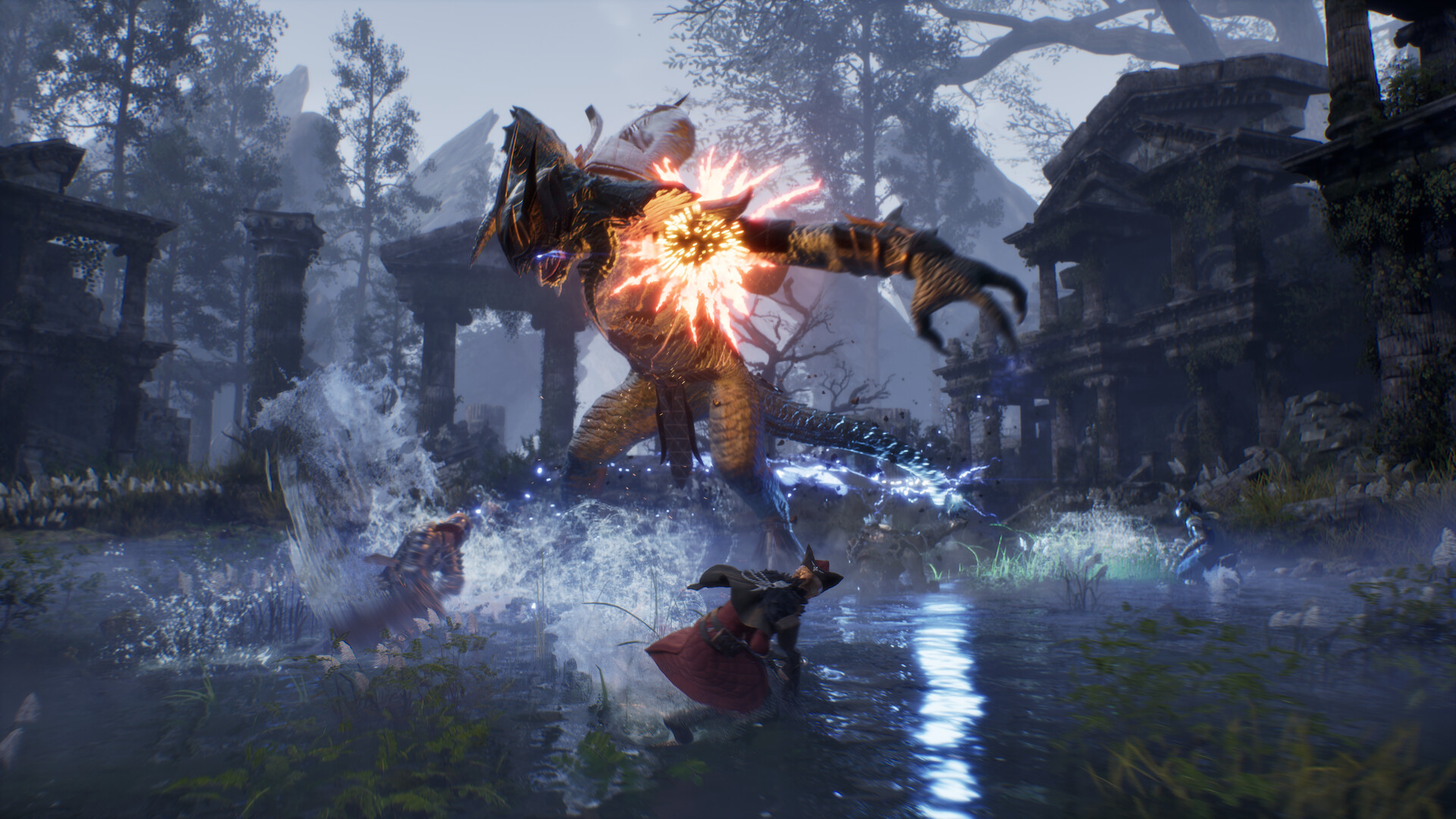
Trait points come from Raeven Coilstones, and every one of them sits near a powerful boss. Some of those bosses stand out in the open, some are hidden, and some only appear through particular quests. If you have found a Coilstone, the studio says, there is a fight standing between you and it.
That is the mechanism behind the exploration promise: a boss you finally beat hands back a new skill or a new way to play, not just a number.
The number of Coilstones per zone is unpublished, as is whether every Coilstone boss is soloable at demo level.
Nui Tears raise maximum HP
Nui Tears are scattered across the open world. Carry them to a Nui Statue and your maximum HP goes up, which in practice means a few more hits before you go down.
The curve is deliberately back-loaded: the first increases cost only a handful of tears and each one after that costs a few more. The studio frames it as something built over a whole journey rather than maxed in an afternoon. The same Nui Statues are also the place you switch between standard and PvP channels.
Tear counts per upgrade and the HP gained per upgrade are unpublished.
Hersander's Tower and the Hereafter Challenge
Every zone hides a set of Hersander's Tower, and Hersander is the god of gambling with particular tastes. Each tower gives you a riddle describing the item it wants. Sometimes the answer is down the road; sometimes it is somewhere you would never look unless you were paying attention.
Satisfy every tomb in a zone and you get a unique accessory plus access to the Hereafter Challenge, where Hersander throws a souped-up version of one of that zone's bosses at you against a clock. Clear time goes on a leaderboard.
Tower counts per zone, riddle texts and accessory slots are unpublished. Nothing here should be treated as a solver.
Chests are first-come but not contested
Treasure chests range from sitting in plain sight to hiding behind the waterfall you almost skipped. They hold gear, rare crafting recipes and other aids.
The important rule for a shared world: chests and other discoverable objects can be opened once per character, so you are never racing another player to reach one first. Finding it late costs you nothing but time.
Loot tables and drop rates are unpublished. Do not expect a chest list from this page.